



WordPress site migrations, bulk content updates, and database cleanup tasks all share one requirement: making the same change in many places at once. A search and replace plugin handles this without manual SQL or phpMyAdmin access — and the right choice depends on the problem you are solving.
This guide compares the five most-used options and maps each to the specific scenario where it works best.
TL;DR: Which Plugin Should You Pick?
| Plugin | Best for | Free vs. Pro |
|---|---|---|
| CM On Demand Search And Replace | Front-end phrase and HTML replacement without database writes | Free + Pro |
| Search & Replace | Domain migration, HTTP→HTTPS conversion | Free |
| Better Search Replace | Safe serialized data handling; the standard recommendation for staging-to-live URL swaps | Free + Pro |
| Better Find and Replace | Real-time image replacement with dry-run preview | Free |
| ACF: Better Search Plugin | Extending WordPress search to cover ACF custom fields | Free |
Contents
- TL;DR: Which Plugin Should You Pick?
- Why Use a Search and Replace Plugin?
- Top 5 WordPress Plugins for Effective Search and Replace Functionality
- 1. CM On Demand Search And Replace
- 2. Search & Replace
- 3. Better Search Replace
- 4. Better Find and Replace
- 5. ACF: Better Search Plugin
- Handling Serialized Data
- What to Do If Search-and-Replace Breaks Your Site
- Conclusion
- Related Articles:
Why Use a Search and Replace Plugin?
Three scenarios cover the majority of real-world needs.
Domain migration / staging-to-live URL replacement — pushing a staging site to production leaves hardcoded staging URLs in the database: in post content, widget settings, theme options, and serialized plugin data. A plain SQL UPDATE fixes plain strings but silently breaks serialized values. See the Handling Serialized Data section below for why this matters.
Bulk content edits across many posts — rebranding a product name, correcting a site-wide spelling error, or updating a policy URL across hundreds of posts. Manual editing does not scale reliably.
Serialized database repair — WordPress stores theme customizations, widget data, and many plugin configuration arrays as PHP-serialized strings. Fixing a staging URL in one of these values requires a tool that understands PHP serialization, not just text matching.
| Scenario | Recommended plugin |
|---|---|
| Staging-to-live URL replacement | Better Search Replace or Search & Replace |
| Bulk post and page text edits | CM On Demand Search And Replace |
| Serialized database repair | Better Search Replace |
| ACF custom field search | ACF: Better Search Plugin |
Top 5 WordPress Plugins for Effective Search and Replace Functionality
Here are the five plugins reviewed in detail.
- CM On Demand Search And Replace
- Search & Replace
- Better Search Replace
- Better Find and Replace
- ACF: Better Search Plugin
🔥GET STARTED WITH WP STAGING TO EFFICIENTLY MANAGE BACKUPS & CREATE STAGING ENVIRONMENTS.
1. CM On Demand Search And Replace
CM On Demand Search And Replace replaces words or phrases across your WordPress site without writing to the database. It intercepts content at render time, so changes are non-destructive and reversible by toggling the rule off — no SQL involved.
The plugin lets you exclude specific pages or post types from a replacement rule and handles bulk HTML corrections (font styles, layout class names) across multiple pages in one pass. Unlike database-level tools, it is safe to test on a live site without a backup, though a backup is always recommended.
Key Features of CM On Demand Search And Replace
- Render-time replacement — no permanent database writes unless you explicitly save changes.
- Exclude specific pages or post types from a rule.
- Automate HTML corrections across multiple pages.
- Content placement scheduling.
- Filter outdated phrases or broken links site-wide.
When to use: bulk phrase or HTML fixes where you want to preview and easily reverse the change without touching the database.
Known limitation: because replacements run at render time, they are not reflected in REST API responses, database exports, or direct database queries — front-end output only.
Download
2. Search & Replace

The Search & Replace plugin operates directly on the WordPress database and covers the most common migration scenario: restoring correct URLs or domain names when transferring a website between hosts or converting from HTTP to HTTPS.
It includes backup and restore functions so the original database state is recoverable before a replace runs. The dry run mode shows matched rows before any change is committed. SQL file download is available for offline review.
Key Features of Search & Replace
- Direct database interface.
- Supports multiple WordPress sites.
- HTTP to HTTPS URL replacement.
- Dry run mode and SQL file download.
- Handles serialized data.
When to use: domain migrations and HTTP→HTTPS conversions where you need a direct database replace with a pre-run preview.
Known limitation: as with any direct database tool, run a dry run first; changes are not reversible without a backup. Verify multisite compatibility against your WordPress version before deploying.
Download
3. Better Search Replace
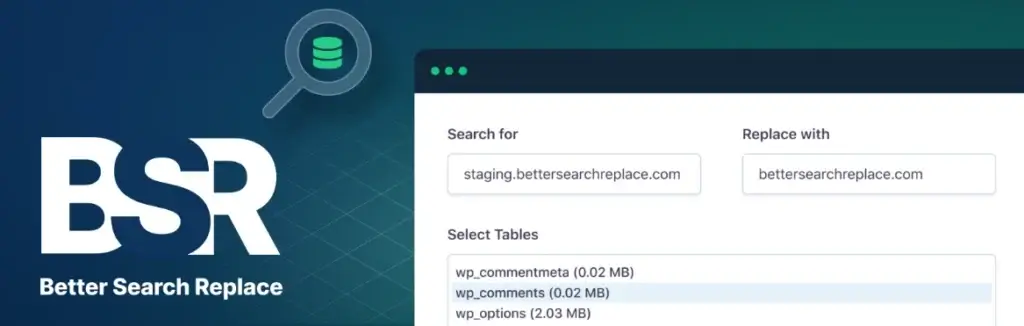
Better Search Replace is the most widely recommended option for staging-to-live URL swaps because it handles PHP-serialized data correctly. When WordPress stores option values or plugin settings as serialized arrays, a plain string replace breaks the byte-count embedded in the serialized wrapper. Better Search Replace deserializes each value, applies the replacement to the actual string, then reserializes with the corrected byte count.
In our testing with WP STAGING staging clones, Better Search Replace handled serialized option values without corruption, including nested arrays stored in wp_options.
It also supports WordPress Multisite and lets you target specific tables for replacement, limiting the scope of a change to only the tables you need.
Key Features of Better Search Replace
- Safe serialization handling across all tables.
- Selective table targeting for precise replacement scope.
- Dry run mode to preview changes before committing.
- WordPress Multisite compatible.
- Requires only a running WordPress installation — no extra server configuration.
When to use: any replacement involving serialized database values, particularly staging-to-live URL swaps after using WP STAGING. This is the first plugin to install for post-migration cleanup.
Known limitation: the free version covers the core use cases described here; a Pro version adds a migration assistant and additional automation features. Check the wordpress.org listing for the current feature comparison.
Download
4. Better Find and Replace

Better Find and Replace covers the standard database search-and-replace use cases — text, URLs, and serialized data — and adds real-time image replacement. This is useful when refreshing product images or updating a logo without manually hunting every occurrence in the media library.
The dry run mode previews which rows will change before any update runs. Specific database tables can be targeted to limit scope.
Key Features of Better Find and Replace
- User-friendly interface.
- Real-time image replacement.
- Dry run preview before committing changes.
- Serialized data support.
- Target specific database tables for replacement.
When to use: media-heavy sites where image references need updating alongside text replacements, or as an alternative to Better Search Replace when image replacement is a priority.
Known limitation: as with any direct database tool, run a dry run first and have a current backup ready. Evaluate both Better Find and Replace and Better Search Replace against your WordPress version before choosing.
5. ACF: Better Search Plugin
The ACF: Better Search Plugin targets a different problem than the other four: it extends the WordPress front-end search to include Advanced Custom Fields data. Standard WordPress search indexes only post title, content, and excerpt — custom field values are invisible to it.
The plugin modifies the underlying SQL query without requiring any changes to the search results template. It suits small and medium sites with straightforward structures; test performance on sites with large custom field datasets before deploying at scale.
Key Features of ACF: Better Search Plugin
- Extends WordPress search to cover ACF custom fields.
- No search results template modifications required.
- Supports multiple field types: text, email, URL, and others.
- Lightweight design to limit search performance impact.
- Custom search fields configurable via shortcodes and widgets.
When to use: sites built heavily around ACF custom fields where visitors need to search content stored in those fields.
Known limitation: designed specifically for ACF custom field search — not a database search-and-replace tool and will not update database content.
Download
Handling Serialized Data
WordPress stores a large amount of configuration as PHP-serialized strings in the wp_options table. A serialized value looks like this:
a:2:{s:3:"key";s:5:"value";s:4:"key2";s:6:"value2";}The prefix s:5:"value" means "a string of exactly 5 characters with the value ‘value’". A plain REPLACE() SQL query that changes "value" to "longer_value" would produce s:5:"longer_value" — the declared byte count is now wrong. PHP cannot unserialize this and throws a fatal error on the next page load.
From WP STAGING support tickets, the most common post-migration issue is a hardcoded staging URL left in wp_options — often in the siteurl, home, active_plugins, or widget settings rows — that a plain replace tool silently corrupted.
Better Search Replace and the Search & Replace plugin both handle this correctly: they decode the serialized string, apply the text replacement to the inner value, then re-encode with the corrected byte count.
Before running any replace on a production site, confirm that the plugin you are using explicitly advertises serialized data support.
What to Do If Search-and-Replace Breaks Your Site
Back up before you run any replace. WP STAGING creates a full staging clone or backup before you make changes, giving you a clean rollback point without manual database exports.
If a replace runs and the site breaks, the most likely causes are:
- Serialized data corruption — if the site shows a white screen or PHP fatal error after a replace, restore from backup and rerun using a plugin with explicit serialized data support (Better Search Replace is the standard choice).
- Home URL or site URL in
wp_optionsnot updated — if the homepage redirects to the wrong domain after a migration replace, checkwp_optionsfor thesiteurlandhomekeys. These must match the new domain. Use Better Search Replace or WP-CLI (wp search-replace) to update them safely. - Hardcoded URLs in theme or plugin files — database replace tools operate on the database only. Hardcoded URLs in
functions.php, child theme files, or plugin PHP are not touched. Check these manually if the database replace completed without errors but some URLs still point to the old domain.
If the site goes offline after a replace, temporarily set WP_SITEURL and WP_HOME directly in wp-config.php to restore admin access while you diagnose the database state.
Conclusion
Editing the WordPress database manually via MySQL is possible but error-prone at scale — especially when serialized data is involved. The five plugins above cover the main use cases: front-end content replacement, direct database URL migration, serialized data fixes, and extended front-end search.
For staging-to-live migrations in particular, back up with WP STAGING before running any replace operation. A current backup is the difference between a five-minute rollback and a multi-hour restore.
Related Articles:
